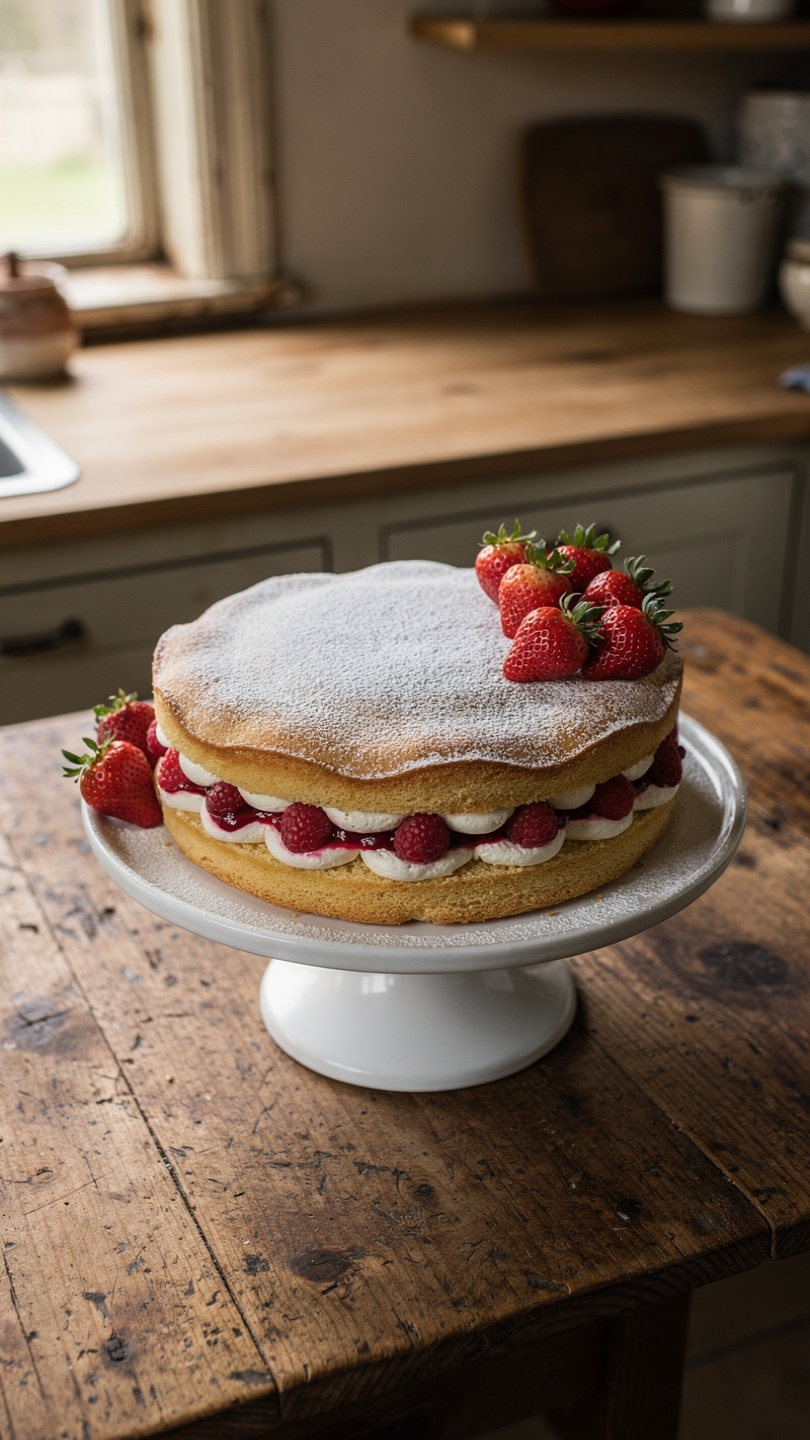
Classic Victoria Sponge Cake
This Classic Victoria Sponge Cake is light, buttery, and filled with sweet jam and whipped cream — the ultimate British teatime treat that looks impressive but comes together with simple pantry staples.

The Cake That Built Afternoon Tea
If there is one cake that defines British baking culture, it is the Victoria Sponge. Named after Queen Victoria herself, who was said to enjoy a slice with her afternoon tea, this cake has been gracing kitchen tables for well over a century. And honestly? It has earned every bit of its legendary status.
What makes it so enduringly beloved is its elegant simplicity. Two golden, buttery sponge layers sandwiched together with fruity jam and billowy whipped cream, then finished with a gentle snowfall of powdered sugar. No fondant. No fussy decorating. Just honest, beautiful baking.
Why This Recipe Works
The secret to a truly great Victoria Sponge lies in the creaming method. Beating the butter and sugar together for a full 4 to 5 minutes traps air into the fat, giving the sponge its signature lift without relying heavily on baking powder. It is the step most home bakers rush, and the one that makes the biggest difference.
A few other things that matter here:
- Room temperature butter and eggs blend together smoothly and emulsify properly, preventing a dense or curdled batter.
- Gentle folding of the flour keeps the gluten relaxed, which means a tender crumb rather than a tough one.
- A splash of milk loosens the batter just enough so it bakes up light rather than stodgy.
Chef's Tip: The batter should fall easily from a spoon in a soft, slow ribbon. If it feels too stiff, add another teaspoon of milk. This is called a "dropping consistency" and it is your best cue that the batter is right.
The Right Tools Really Do Matter
For a cake this simple, precision and the quality of your tools carry a lot of weight. Using a proper electric mixer rather than stirring by hand makes the creaming step genuinely achievable, and good quality pans with straight sides ensure even baking and a professional finish.
Tools & Ingredients We Recommend



Choosing Your Jam
Traditionally, strawberry jam is the filling of choice, but a good raspberry jam is just as classic and adds a lovely tartness that balances the richness of the cream. Whatever you choose, go for a jam with real fruit flavour rather than something overly sweet and artificial. It is one of only a handful of ingredients in this cake, so quality counts.
As for the cream, whip it just to soft peaks. You want it pillowy and spreadable, not stiff or grainy. A little goes a long way.
Serving the Perfect Slice
The Victoria Sponge is best served at room temperature, which allows the butter in the sponge to soften and the flavours to open up fully. Straight from the fridge, the texture can feel a touch tight.
Serve it on a pretty cake stand if you have one. This is a cake that deserves to be shown off. A generous dusting of powdered sugar right before serving keeps it looking fresh and elegant.
Ready to bake your own piece of history? Here is everything you need:
Classic Victoria Sponge Cake
This Classic Victoria Sponge Cake is light, buttery, and filled with sweet jam and whipped cream — the ultimate British teatime treat that looks impressive but comes together with simple pantry staples.
Ingredients
- 1 cup unsalted butter, softened to room temperature
- 1 cup caster sugar, or superfine sugar
- 4 large eggs, room temperature
- 2 cups self-raising flour, sifted
- 1 tsp baking powder
- 2 tbsp whole milk, to loosen the batter
- 1 tsp vanilla extract, pure, not imitation
- 1/2 cup strawberry jam, good quality, seedless or seeded
- 1 cup heavy whipping cream, cold
- 2 tbsp powdered sugar, for dusting the top
Instruction
Preheat your oven to 350 degrees F (175 degrees C). Grease two 8-inch round cake pans and line the bottoms with parchment paper.
In a large bowl, beat the softened butter and caster sugar together with an electric mixer on medium-high speed for 4 to 5 minutes until the mixture is very pale, fluffy, and almost doubled in volume.
Add the eggs one at a time, beating well after each addition. If the mixture begins to curdle, add a spoonful of flour to bring it back together.
Add the vanilla extract and mix briefly to combine.
Sift in the self-raising flour and baking powder. Using a large spatula or wooden spoon, fold gently until just combined. Do not overmix.
Add the milk and fold it in to loosen the batter to a soft, dropping consistency.
Divide the batter evenly between the two prepared pans and smooth the tops with an offset spatula.
Bake for 20 to 25 minutes, or until the sponges are golden, springy to the touch, and a toothpick inserted in the center comes out clean.
Allow the cakes to cool in the pans for 5 minutes, then turn out onto a wire rack and leave to cool completely.
While the cakes cool, whip the cold heavy cream with an electric mixer until it holds soft peaks. Be careful not to overwhip.
Place one sponge layer on a serving plate or cake stand. Spread the jam evenly across the surface, leaving a small border.
Spoon or pipe the whipped cream over the jam layer.
Place the second sponge layer on top, flat side down, and press gently.
Dust generously with powdered sugar and serve at room temperature.
Equipment
- Two 8-inch round cake pans
- Electric hand mixer or stand mixer
- Large mixing bowl
- Rubber spatula or wooden spoon
- Wire cooling rack
- Offset spatula
- Sifter or fine mesh sieve
- Parchment paper
Notes
Storing and Variations
Storage: Once assembled, keep the cake refrigerated and bring it to room temperature before serving. It is best eaten within 2 days of assembly.
Make it your own:
- Swap the whipped cream for a lightly sweetened mascarpone cream for a richer, more stable filling.
- Use lemon curd alongside or instead of jam for a bright, citrusy twist.
- Add the zest of one lemon or orange to the batter for a subtle fruity note in the sponge itself.
However you choose to make it, the Victoria Sponge is one of those recipes that rewards you every single time. Simple ingredients, proper technique, and a little patience that is truly all it takes.